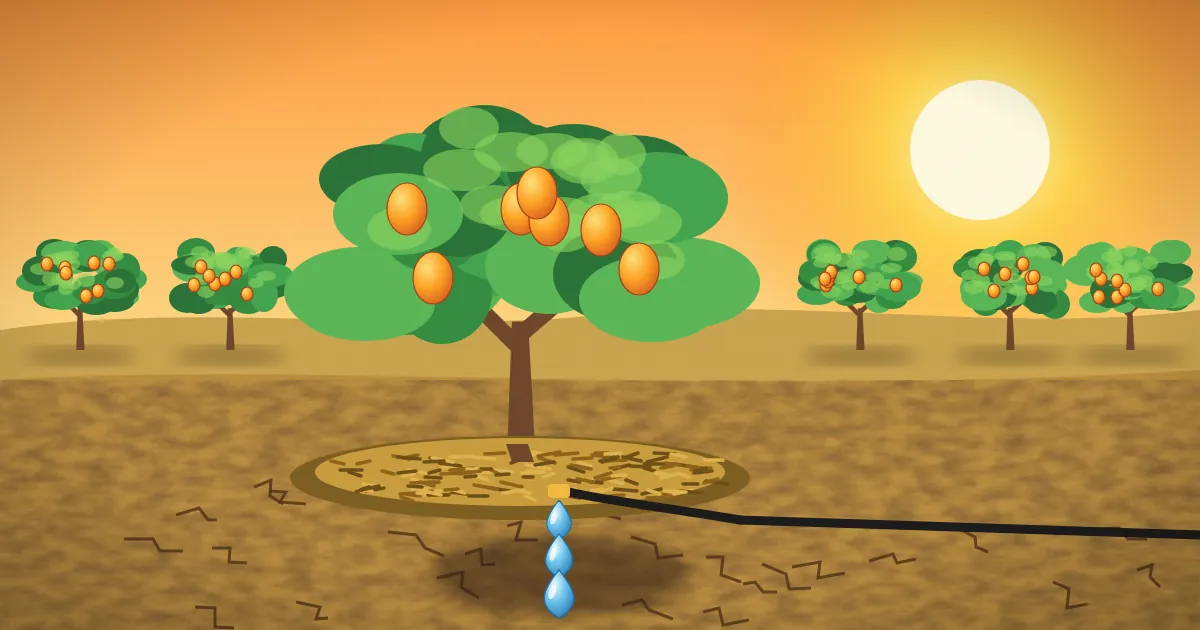
When water runs short, an orchard is at greater risk than a field crop. A vegetable crop lasts one season, but a tree you lose may take five to ten years to replace. The aim in a dry year is simple: keep the trees alive, protect the stages that decide the crop, and waste no water.
Here are five tactics that work, in the order that gives the fastest return.
1. Mulch the basin
Bare soil loses water fast under a hot sun. Mulch keeps it.
- Spread 8 to 10 cm of dry leaves, straw, crop residue or shredded prunings across the tree basin.
- Keep it a hand-width away from the trunk so bark stays dry.
- Add a thin layer of compost below the mulch if you have it. It feeds the soil and holds more water.
- Black or silver plastic mulch also works for young plants, but organic mulch also builds soil.
Mulch cuts evaporation, keeps roots cooler and also stops weeds from competing for water.
2. Water less, but at the right time
Give water where and when the tree needs it most.
- Water the root zone, not the whole field. A drip line, a basin ring or a pitcher near the roots beats flood irrigation.
- Protect critical stages. Flowering, fruit set and early fruit growth usually decide the yield. A short stress at a less sensitive stage often costs less. Ask your KVK for the stages for your crop.
- Irrigate early morning or evening to cut evaporation.
- Check before you water. Push a stick or a hand trowel 15 to 20 cm into the soil near the roots. If it is still damp, wait.
- Fix leaks first. A leaking pipe or open channel can waste more than a dry spell saves.
3. Lower what the tree asks for
A tree with less leaf and less fruit needs less water.
- Light pruning of crowded or dead branches. Avoid heavy pruning, which exposes bark to sunburn.
- Thin the fruit if the load is heavy, so the tree can finish the fruit it keeps.
- Remove weeds and suckers inside the basin. They steal water.
- Whitewash trunks and main branches to cut heat. Some orchards use reflective sprays such as kaolin on leaves and fruit. Ask your dealer or KVK whether it suits your crop.
- Go easy on nitrogen. Heavy nitrogen creates soft, thirsty growth.
4. Store more water in the soil
Every drop that stays in the root zone is a drop you do not have to pump.
- Dig a half-moon trench or small bund on the low side of each tree to catch rain and run-off.
- Add compost or farmyard manure to the basin. Soil rich in organic matter holds far more water than bare, hard soil.
- Avoid deep digging in the dry season. It dries the soil further.
- For saplings, a buried clay pot or a plastic bottle with a small hole can deliver water slowly to the roots with very little loss.
5. Set priorities and keep watching
In a severe dry spell you cannot save everything. Decide early:
- Young trees and high-value trees first.
- Weak, old or low-yield trees last.
- Keep a record of how much each block receives and how the trees respond.
- Walk the orchard each week. Curling leaves in the morning, dry twig tips and early leaf drop show stress.
Give inputs in small, measured doses
In dry soil, fertilizer and other inputs can burn roots if they are strong or uneven. Apply small, measured doses near the roots and only when the soil has some moisture. The SWASTI Auto Soil Drenching Device lets you set a dose from 20 ml to 500 ml per plant, which suits young plants, nursery bags and gap filling. It does not replace irrigation, and large trees need litres of water, so use drip, basin or other irrigation for that. See measured dose per plant and soil health basics.
A one-page checklist
| Task | Done? |
|---|---|
| Mulch every basin, away from the trunk | |
| Fix leaks and check pipes | |
| Water at the critical stages first | |
| Irrigate early morning or evening | |
| Remove weeds in basins | |
| Whitewash trunks, light pruning only | |
| Reduce nitrogen, measured doses only | |
| Mark priority trees and record watering |
Before you apply anything
Read the label of any spray or product, wear gloves and a mask, and keep products away from children and food. Water needs differ by crop, soil and region, so ask your local agriculture officer or KVK for advice on your orchard.
अक्सर पूछे जाने वाले प्रश्न
Which trees should I save first when water is very short?
Save the trees that took the longest to grow and that give the most income, and young plants that cannot survive a dry spell yet. It is better to keep fewer trees fully alive than to under-water all of them.
How thick should mulch be, and what material works?
A layer of about 8 to 10 cm of dry leaves, straw, crop residue or shredded prunings works well. Keep it a hand-width away from the trunk so the bark stays dry and rot does not start.
Should I stop fertilizer during a dry spell?
Cut back, do not stop blindly. Heavy fertilizer in dry soil can burn roots and push soft growth that needs more water. Use smaller, measured doses near the roots and follow your soil test and local advice.
Will less water reduce my fruit yield?
It can, if the stress comes at the wrong time. Flowering, fruit set and early fruit growth are usually the most sensitive stages. Ask your KVK for the critical stages of your fruit crop and protect those first.
यह सामान्य जानकारी है। आपकी मिट्टी, फसल और क्षेत्र के अनुसार तरीका अलग हो सकता है, इसलिए अपने स्थानीय कृषि अधिकारी या KVK से सलाह लें।