Every farmer asks the same question before a season: should the input go on the leaves or into the soil? The honest answer is that neither method wins every time. What saves money is using the right method for the job, and putting the right amount on every plant.
Where the money is lost in foliar spraying
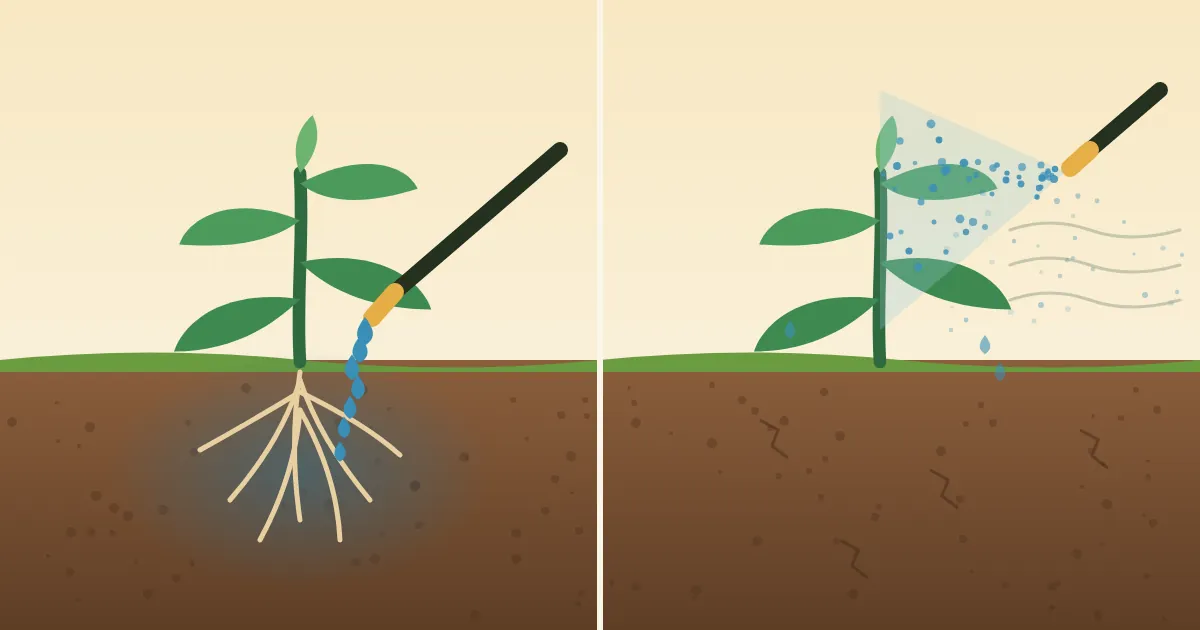
A foliar spray covers the whole plant, but a lot of it never does its job:
- Wind drift carries fine droplets away from the crop.
- Run-off and wash-off happen when rain or dew comes soon after spraying.
- Evaporation in hot, dry hours dries the droplets before the leaf can absorb them.
- Uneven coverage leaves the underside of leaves and the lower canopy untouched.
When a part of the spray is lost, farmers often spray again or add more product. That is where cost grows.
Where the money is lost in root-zone drenching
Drenching has its own risks, and they are mostly about the dose:
- Pouring "by eye" gives some plants too much and others too little.
- Too much liquid in one spot can run past the roots or collect in a low area.
- Wet soil right after heavy rain can wash the input away.
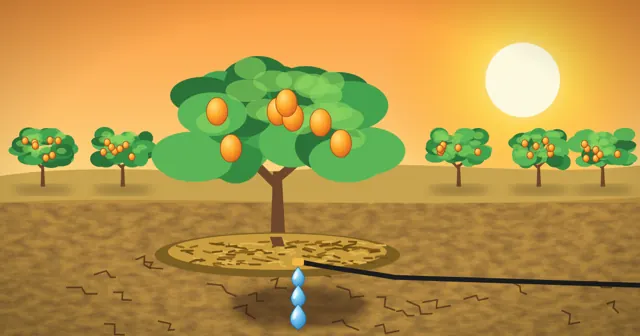
The fix is simple: apply a measured dose per plant, near the root zone, when the soil is not waterlogged.
Drenching vs. foliar spraying at a glance
| Question | Root-zone drenching | Foliar spraying |
|---|---|---|
| Where does the input go? | Into the soil near the roots | On leaves and stems |
| Best for | Soil-borne problems, root feeding, steady supply | Leaf pests, leaf diseases, quick correction of a deficiency |
| Main losses | Wrong dose, run-off from waterlogged soil | Drift, wash-off, evaporation, poor coverage |
| Speed of effect | Slower, through the roots | Faster, through the leaves |
| Biggest saving comes from | Measured dose per plant | Right timing and good coverage |
So which one saves more?
- For soil-borne problems and root feeding, drenching usually wastes less, because the input goes straight to the root zone instead of spreading over the whole plant and the air around it.
- For leaf problems and a fast deficiency fix, a foliar spray is still the right tool. Drenching will not replace it.
- For the lowest cost overall, the biggest saving does not come from the method. It comes from applying a controlled dose to each plant and not repeating applications because the first one was lost or uneven.
A simple way to decide
- Where is the problem, in the soil or roots, or on the leaves?
- Read the product label for the method and the dose it allows for your crop.
- Check the weather. Avoid windy hours for spraying and avoid waterlogged soil for drenching.
- Apply a measured dose to each plant, instead of pouring or spraying by eye.
- Note what you used on each plot so next season you can compare cost and result.
Making the dose even
The hardest part of drenching by hand is giving every plant the same amount. The SWASTI Auto Soil Drenching Device helps with this. You set the dose from 20 ml to 500 ml, and it fits any battery sprayer pump, so you do not need a new pump. It is priced at ₹699 with free delivery across India.
Before you apply anything
Read the label, wear gloves and a mask, and keep products away from children and food. Doses and methods differ by crop and product, so if you are unsure, ask your local agriculture officer or KVK first.
अक्सर पूछे जाने वाले प्रश्न
Does soil drenching save more fertilizer than foliar spraying?
It depends on the job. Drenching puts the dose where roots can take it up, so less is lost to wind and wash-off, and it suits soil-borne problems and root feeding. Foliar spray is better for quick correction of a deficiency or for pests on the leaves. Neither is better for every case.
Can I replace all my foliar sprays with drenching?
No. Leaf pests, leaf diseases and quick micronutrient correction still need a foliar spray. Drenching is the better tool for soil-borne problems and for feeding through the roots.
How do I make sure each plant gets the same dose when drenching?
Use a measured dose per plant instead of pouring by eye. The SWASTI Auto Soil Drenching Device lets you set the dose from 20 ml to 500 ml and fits any battery sprayer pump.
Where do I find the right dose for my crop?
Always follow the product label. If the label does not cover your crop, ask your local agriculture officer or KVK before you apply.
यह सामान्य जानकारी है। आपकी मिट्टी, फसल और क्षेत्र के अनुसार तरीका अलग हो सकता है, इसलिए अपने स्थानीय कृषि अधिकारी या KVK से सलाह लें।