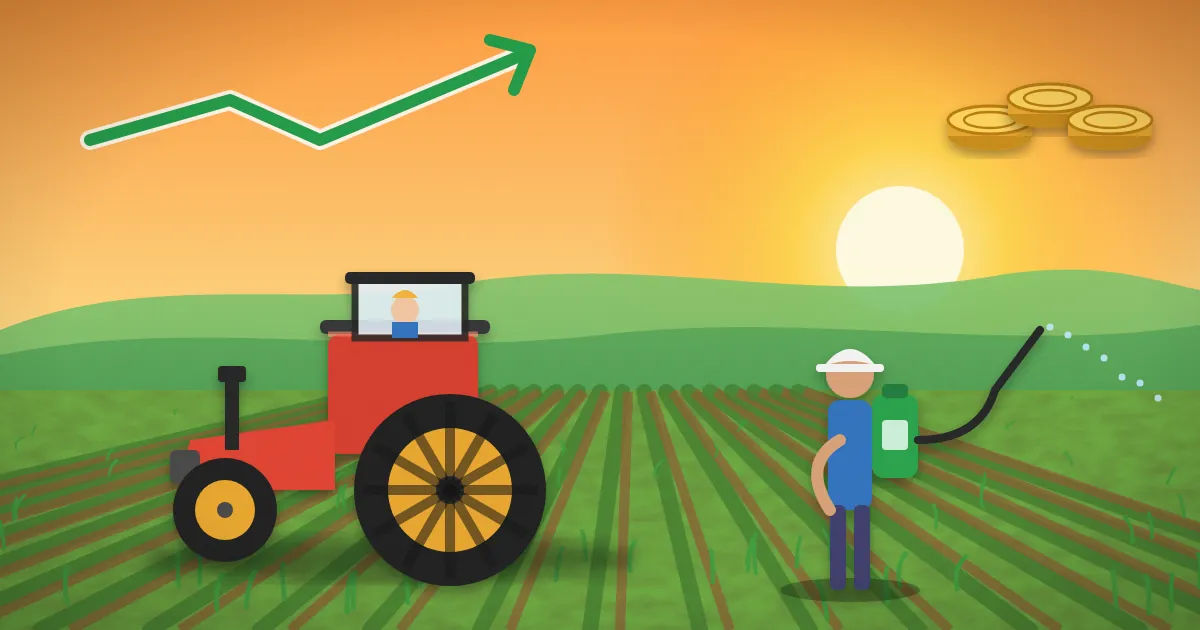
On a small or medium farm, a big tractor rarely makes sense. But small, well-chosen tools often do. The tools that pay back fastest are the ones that save labour at a time when labour is scarce or costly, save inputs, or save time at a critical stage like sowing or weeding.
This guide shows which tools to look at first and how to do your own break-even maths before you spend a rupee.
The break-even formula
Use this for every machine:
Payback (in seasons) = Machine cost ÷ Saving per season
Saving per season = (labour days saved × daily wage) + (inputs saved) + (value of better timing or yield) − (fuel, repair, operator and interest)
Here is an example with assumed numbers only. Replace them with your own.
| Item | Assumed figure |
|---|---|
| Power weeder price | ₹30,000 |
| Hand weeding per acre per pass | 6 labour days × ₹400 = ₹2,400 |
| Machine weeding per acre per pass | ₹700 (fuel and one operator) |
| Saving per acre per pass | ₹1,700 |
| Passes per season | 3 |
| Acres weeded | 5 |
| Saving per season | ₹1,700 × 3 × 5 = ₹25,500 |
| Payback | ₹30,000 ÷ ₹25,500 = about 1.2 seasons |
With 8 acres the same machine pays back in about three-quarters of a season. With 2 acres it will take years. The acres you cover decide everything.
Tools that usually pay back first
| Tool | Where the saving comes from | Good fit when |
|---|---|---|
| Battery or knapsack sprayer | Faster work, less tiredness, even coverage | Any farm with sprays through the season |
| Measured-dose applicator (for example the SWASTI device) | Even dose per plant, less wasted input, less time than pouring by hand | Orchards, vegetables, plantation and row crops where inputs go to the roots |
| Power weeder or mini tiller | Weeding labour | Row crops, vegetables, orchards, 4 or more acres |
| Seed drill or planter | Seed saving, even spacing, faster sowing at the right time | Cereals, pulses, maize, soybean |
| Simple thresher or sheller | Harvest labour, less grain loss | Maize, groundnut, paddy |
| Pruning shears (cordless) | Labour in orchards | Mango, pomegranate, grapes, citrus |
| Drip kit | Water, labour and fertilizer | Vegetables, orchards, sugarcane. See drip maintenance. |
What it really costs to own a machine
Many farmers count only the price. Also count:
- Fuel or charging and oil
- Repairs and spares, and how far the nearest mechanic is
- Operator time and training
- Storage and protection from rain and rust
- Interest on the money you spend, or the loan
- Idle time, when it sits unused
A cheap machine used on only 1 acre rarely pays back. A good machine shared between 3 farmers often does.
Buy, share or hire?
- Used on many acres, many times a year: buy.
- Used a few days a year: hire from a custom hiring centre, a farmer producer organisation (FPO) or a neighbour.
- Costly machine or unsure: hire it first on a small plot to test it, or buy with 2 to 3 farmers.
- Machine that must work at a fixed time (sowing, harvest): make sure you can get it on the right day. A late machine loses the saving.
Look for subsidy support
Many state governments support farm machines, often with higher rates for small and marginal farmers, women and SC/ST farmers, through schemes such as the Sub-Mission on Agricultural Mechanization. The machines covered, the rates and the way to apply differ by state and year. Ask your taluka or district agriculture office before you buy, because some schemes need approval first.
Choose a machine in six steps
- Write down the job it must do and how many acres a year.
- Do the break-even sum with your own wage and fuel rates.
- See it work on a farm like yours, not only in a showroom.
- Check service: where do you get spares and repairs, and how fast?
- Check safety: guards, handles and noise. Train every operator.
- Keep records for one season: hours used, fuel, repairs and labour saved. Then you know your real payback.
A small tool that adds up
Not every saving needs a big machine. Pouring a drench or fertilizer by eye wastes product and gives uneven results. A measured dose does not. The SWASTI Auto Soil Drenching Device (₹699) lets you set a dose from 20 ml to 500 ml and fits any battery sprayer pump. As an illustration only: if you spend ₹10,000 a season on inputs applied at the roots and an even dose saves 7%, that is ₹700. Your result may be more or less. It depends on how much you over-apply now. See how to give a measured dose per plant and battery sprayer pump care.
Before you buy or apply anything
Read the manual and label, wear gloves, a mask and ear and eye protection, and keep machines and products away from children. Prices, wages and subsidy rules change, so check the current figures locally.
વારંવાર પૂછાતા પ્રશ્નો
How do I know if a machine will pay back in one season?
Divide the machine price by your yearly saving. Your saving is the labour days saved times the daily wage, plus the value of inputs and time saved, minus fuel, repair and operator cost. If the answer is less than one season of use, it can pay back in a season. Use your own numbers, not someone else's.
Should I buy or hire the machine?
Buy if you will use it on enough acres every year and can look after it. Hire, share or use a custom hiring centre if you will use it only a few days a year, or if the machine is costly. Hiring also lets you test the machine before you buy.
Is there a government subsidy for farm machines?
Many states offer subsidy support for farm machines, often with higher rates for small and marginal farmers, women and SC/ST farmers, under schemes such as the Sub-Mission on Agricultural Mechanization. Rates, machines and rules differ by state and year, so check with your taluka or district agriculture office before you buy.
Do I need a big tractor to mechanize?
No. On small farms the best returns often come from small, low-cost tools: a good sprayer, a power weeder, a seed drill or planter, a simple thresher or sheller, and measured-dose applicators.
આ સામાન્ય માહિતી છે. તમારી જમીન, પાક અને વિસ્તાર મુજબ રીત અલગ હોઈ શકે, તેથી સ્થાનિક ખેતી અધિકારી અથવા KVK ની સલાહ લો.